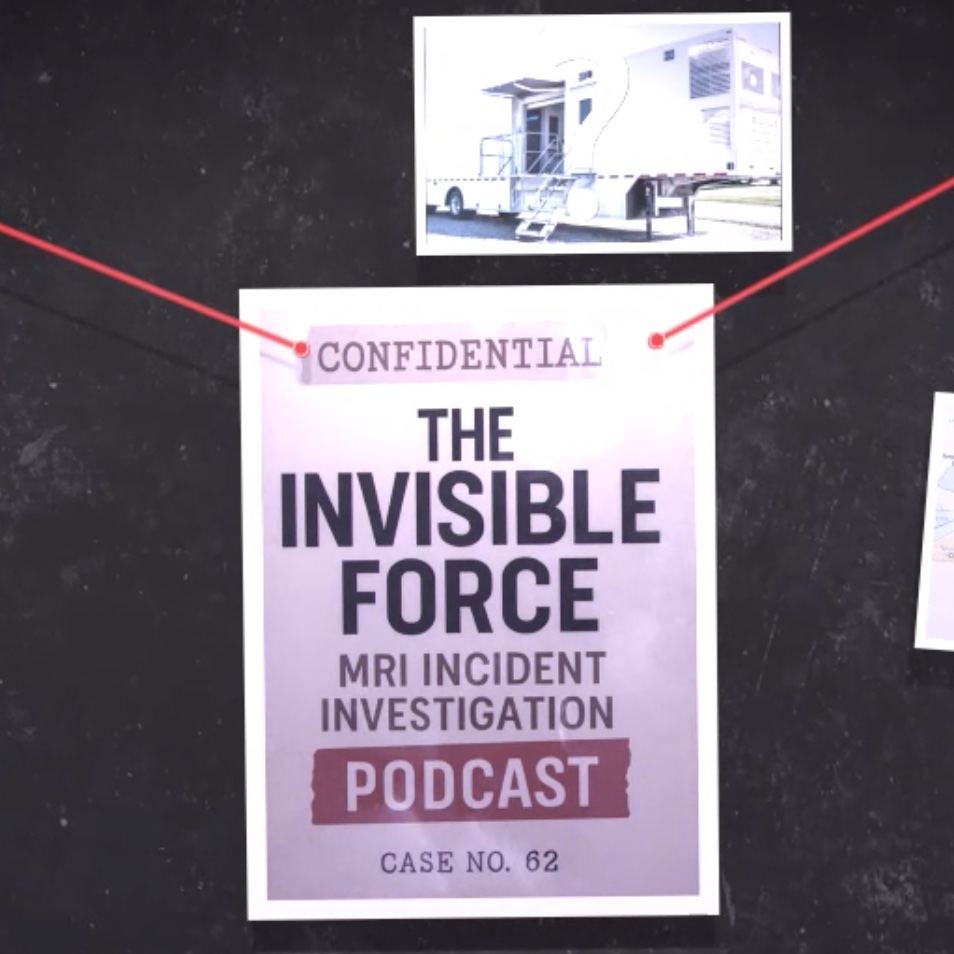
A six-year-old boy survives brain tumor surgery and is preparing to go home. Then a routine MRI turns into one of the most infamous accidents in medical history.
In this episode of the Invisible Force podcast, we continue our investigation into the mystery of the 2001 MRI accident that claimed the life of Michael Colombini at Westchester Medical Center in New York. After an oxygen system failure inside the MRI suite, a steel oxygen cylinder was brought into the scanner room and was violently pulled into the MRI magnet, striking the young patient and triggering a tragedy that would permanently change the conversation around MRI safety.
In our documentary style, we examine the frantic effort to rescue Michael from the MRI scanner, the hospital’s public response, and the national media coverage that followed. We also explore the New York State Department of Health investigation, the role of hospital leadership, and the extraordinary statement by Westchester Medical Center CEO accepting responsibility for the care of the hospital’s patient.
The second half of the episode follows the Colombini family’s wrongful death lawsuit against the hospital, physicians, MRI personnel, and MRI manufacturer GE Healthcare. Through court records and legal filings, we explore how the case shaped understanding of MRI technologist responsibilities, physician oversight, hospital liability, medical negligence, and MRI safety standards.
This episode also examines how one of the most significant MRI accidents ever recorded helped drive the creation of modern MRI safety guidance, including the work that would eventually lead to the American College of Radiology’s MRI safety framework.
Show Notes:
Westchester County Clerk’s Office (Case Index No. 11101/2002)
ABC News Story
CBS News Story
Clinician.com News Story
Transcript:
“Thank you for showing me how to change out the tank. I probably could have figured it out myself, but it would have kept that anesthesiologist waiting a lot more than those ten minutes. Who is he, by the way?”
“Not a problem. I’m glad you now know how to do it. We should probably make sure that swapping the tanks is part of a new tech orientation. And as for the anesthesiologist, I don’t think I’ve… I’ve never seen him here before.”
“Make a hole!”
“Hold that door!”
“What happened to my son?”
“Keep up and keep bagging him!”
“Oh my god, what happened?”
Hello, and welcome back to the second series of the Invisible Force podcast. Invisible Force is an investigative documentary podcast about MRI accidents, patient safety failures, healthcare mysteries, and some of the hidden risks of modern medicine. This second season is dedicated to an MRI accident that really launched contemporary MRI safety 25 years ago in July of 2001.
This accident, the tragedy that took the life of six-year-old Michael Colombini, occurred at Westchester Medical Center just outside New York City. Through this series, we’re describing this accident for you and how it became a watershed moment for MRI safety.
But before we continue into the second series of Invisible Force and the story of Michael Colombini, let’s reintroduce our hosts.
Hello, I’m John Posh. I’m an MRI technologist and MRI educator, a long time advocate of MRI safety practices. I’m also on faculty at two universities and teach MRI safety multiple times per year.
And I’m Toby Gilk, certified MRI safety officer, MRI safety expert, MRI facility architect and consultant. And I’m a co-author of a new MRI safety textbook, The Technologist’s MRI Safety Handbook.
In our last episode, we shared with you the Shakespearean-level tragedy that had all the twists and turns of a gripping screenplay. The happy-go-lucky little boy, the frightening playground accident, which turned out to be not so frightening after all, except for the surprise and terrifying diagnosis of a brain tumor. The surgery of which successfully removed the tumor and returned the expectation of a long and healthy life for the boy. The only thing left for the family on that particular hospital visit was to get a baseline MRI, against which future scans would be compared.
During that last thing before discharge MRI, it appears that young Michael Colombini was over-sedated. His breathing slowed and his oxygen levels started dropping fast. The in-room oxygen cylinder didn’t work. No matter which way the anesthesiologist turned the valve, no oxygen would flow. Without telling the anesthesiologist, the MRI techs went into the soundproofed equipment room to try and fix the problem with the oxygen. The anesthesiologist worried about the young boy was calling out to the techs or so he thought about getting the oxygen working, but of course they didn’t answer. A nurse led herself into the MRI suite, found a couple of portable oxygen tanks and handed one to the anesthesiologist. The anesthesiologist then took a few steps into the MRI room with the oxygen cylinder, only to have the MRI’s magnetic field rip the tank out of his arms, where it flew into the bore of the scanner, and this is where we left you at the end of our last episode.
That steel tank, effectively a magnet homing missile at this point, it flew right at the opening of the tube of the MRI scanner, exactly where young Michael was positioned. The impact of the flying tank shattered the helmet-like head coil that the boy’s head was in, and it hit him in the face. The inertia of that flying tank, it took it past the boy, through the MRI’s tube, flying out the other end of the MRI scanner, but that’s where the magnetic field pulled it back in. On its way back into the tube of the MRI, it struck the boy again, this time on the top of his head. Remember, the day before, he had his skull cut open to allow for the brain surgery. Even though he was struck at least twice and very badly injured, the boy was alive. The anesthesiologist and the nurse called the code team to come and help get the boy out of the MRI and get him to the emergency room.
The code team arrived to find the bloody boy pinned against the inside of the tube wall of the MRI scanner by the oxygen tank, still held in place by the magnetic force of the MRI. Unfamiliar with how to safely extract someone from a situation like this, they called the hospital’s emergency department to get them to send a paramedic team who had just dropped off an ambulance patient to MRI to aid in the extraction of the boy. Together, the code team, the paramedics, the anesthesiologist and the nurse got Michael out of the MRI scanner and on to a gurney and started running him out of the MRI edition to the emergency room.
Do you know who we haven’t yet mentioned? You may remember from last episode that Michael Colombini’s father was in the MRI waiting room during all of this. He likely heard the crash, the screams, saw the code team rush in, followed shortly by the paramedics. Even if he didn’t go back to learn what exactly was going on, he had to be aware that something was going horribly wrong with his son. We also haven’t mentioned the role that the MRI technologists, who you’ll remember, disappeared into the MRI equipment room to fix the oxygen supply. We didn’t mention the role that they had in pulling young Michael out of the MRI scanner. It’s around this time when the platoon of responders are wheeling the boy down the corridor and out of the MRI suite, that the MRI technologists emerge from the MRI equipment room, and they’ve got the good news that they’ve fixed the oxygen system, so it should be fine to use now. They had no idea of what was happening during the several minutes that they were in the equipment room, cut off from the rest of the MRI suite.
A little while later, in the emergency department, as serious as his injuries were, at first Michael seemed to be responding to the treatment and stabilizing. But on the second day, he started to decline, and nothing at the hospital tried reversed his downhill slide. The young boy was dead two days after the horrific MRI accident. Reading his medical records, you watch his decline feeling almost as helpless to stop this thing that happened 25 years ago, as the doctors and nurses must have felt in real time.
Probably because Valhalla, New York is just an hour’s drive from Manhattan and close to all the national broadcast headquarters, and probably also home to a few New York Times reporters. Well, this accident was all over New York City news, as well as national media. While the internet technically existed in 2001, it wasn’t anything like what we know it as today. But satellite news trucks were parked all around the hospital, and CNN, back when it was a big time national TV news authority, ran all sorts of breathless updates from the front lawn of the hospital.
The CEO of the hospital, a gentleman by the name of Ed Stolzenberg, made the most brave, and if you ask the hospital’s attorneys, foolish statements about the accident to the press. He said something to the effect of, he was our patient, we were responsible for his care, and so we’re responsible for everything that happened to him while he was our patient. Mr. Stolzenberg also identified this accident as being attributable to a systemic issue with the hospital and not the failings of individuals.
For listeners who were with us for our first series on the Long Island Nassau Open MRI Accident, you’ll remember that the New York State Department of Health kinda threw up their hands in helplessness, jurisdictional impotence, because Nassau Open MRI wasn’t a state-licensed facility. Well, Westchester Medical Center was a state-licensed facility. And indeed, the Department of Health did descend and conduct an investigation. The state was in a bit of a bind, however, because then, as now, New York didn’t have any minimum MRI safety requirements.
The state’s report identified a number of things that were wrong or had gone poorly with regard to MRI safety at Westchester Medical Center. But as rational and reasonable as those things were, the state of New York couldn’t actually cite the hospital for violating any state MRI safety rules when no state MRI safety rules existed. Though it’s not as if the hospital got off completely free, because the code violations in the medical gas system and its contribution to the death of the boy, the hospital was fined a grand total of $22,000 by the New York State Department of Health. For reference, the estimated payments that a hospital would have been receiving from insurance companies in 2001 for an MRI scan was around $1,000 to $1,500. In other words, the hospital’s fine would probably be around as much as they would have received for two or three days of MRI service.
This accident took place on July 27th, 2001, and the shock waves immediately reverberated through the radiology community. For many of us in MRI, this is a, do you remember where you were when you heard the news moment? But apart from the 24-hour cable news flash in the pan attention, the Colombini story didn’t have much staying power for the general public. This is in part because several weeks after the Colombini accident, airplanes crashed into the two towers of the World Trade Center and the Pentagon, and any residual public interest in this accident was overwhelmed by the 9-11 tragedy. Apart from the reductive headlines, boy dies from flying oxygen tank in MRI scanner. Virtually nobody outside of the diehard radiology people and MRI safety nerds like us remembered the details of this particular story.
The Radiologic Society of North America, RSNA, is a large professional society for radiologists. RSNA holds its annual meeting every year in Chicago, starting the weekend right after Thanksgiving. Months before the Colombini accident, the 2001 meeting had been planned to have a focus on MRI safety issues, much of which paled in the face of the recent tragedy. Lots of scientific meetings like RSNA have sessions on MRI safety that describe advancements like new models of electrical field propagation through inhomogeneous tissues, etc. Confronted with the simple brutality of a flying oxygen cylinder, this must have made more scientific presentations feel a bit soft by comparison. It was around the time of the RSNA meeting that the American College of Radiology formed what was originally called their “Blue Ribbon Panel on MRI safety,” the group that, less than a year later, published the ACR White Paper on MRI safety. But that original white paper and its effects are really the focus of our next episode.
A year later, in 2002, the Colombini family filed a lawsuit against the hospital, the manufacturer of the MRI unit, and at least to begin with, the suit also individually named several people involved. But we’re going to dive into that after our break.
The sponsor of the Invisible Force podcast is carereporting.org. That’s CAIRE spelled C-A-I-R-E. cairereporting.org is a confidential MRI adverse incident reporting system available to all of us, the public, as well as offering an enterprise-level solution to hospitals and imaging centers for secure and confidential reporting of MRI incidents, accidents, and near misses. If you have direct knowledge of an MRI accident that maybe got swept under the rug or if you want information about how CAIRE could be set up as a private internal error reporting tool for your hospital or imaging center, carereporting.org can help you with both of those. CAIRE has an assembled panel of international experts in MRI safety and accidents. Reports submitted either through the public website or through the enterprise system get reviewed by their experts who then deliver insights into the contributing causes of how accidents or near miss events happened and, more importantly, steps that could prevent similar accidents in the future. For more information, please visit cairereporting.org. That’s CAIRE spelled C-A-I-R-E.
In the first half of this episode, we told you about actually getting Michael Colombini out of the scanner and how they were hopeful for his recovery until the boy took a turn for the worse. We also told you about the dizzying media coverage and the honesty of the hospital CEO in taking responsibility for the accident. We told you about how 9-11 wiped the story of Michael Colombini’s tragic death from the news and how almost everyone forgot about it.
But of course, the family couldn’t forget. In 2002, they filed a lawsuit naming the hospital, the MRI techs, the anesthesiologist, the nurse who handed the oxygen tank to the anesthesiologist, and the hospital’s physician director of radiology, who also doubled as the owner of the MRI facilities operations. The hospital had reportedly offered a million-dollar settlement to settle the matter immediately after the accident happened. The family declined this settlement offer, meaning that this lawsuit was going to slowly grind through the courts for the next seven years.
For those who were with us at the end of series one, where we described the particulars of that lawsuit, the McAllister family only sued the companies involved. In that case, at least to begin with, no individuals were named as defendants in that case. For the Colombini accident, however, the lawsuit explicitly named not only the hospital, but also the MRI manufacturer, GE, and individually named both the MRI techs, the anesthesiologist, the nurse, and the director of radiology, who also served as the owner of the MRI center. Even though the Colombini suit never made it to trial, pretrial decisions in the case led to a number of different interpretations and clarifications of the duties of the different individuals, at least under New York state law.
One of the reasons that the Colombini lawsuit may have named so many people individually is because of the strange setup of the MRI facility. As we mentioned in the previous episode, the hospital had recently switched from county ownership to a public benefit corporation. The MRI building and the services it provided, however, that was a separate business entity from the hospital. Dr. Terrence Matalon was not only the director of radiology but also the titular owner of the MRI service company. There were implications that this allowed the hospital to have a low salary for the radiology director on the books, but supplement the director’s salary by also paying them for the MRI service director role too.
This bizarre arrangement extended to more than just the director slash service owner and included the MRI techs as well. On paper, the MRI techs were employees of the separate MRI service. However, their paychecks came from the hospital. It was unclear from the depositions whether Dr. Terrence Matalon, the director of radiology, actually managed the MRI service company or was only a figurehead. It may have been because of this confusion of whether the MRI services business was real or just a bunch of paperwork that the Colombini family’s attorneys named so many individuals.
One thing that MRI technologists often assert as a professional responsibility is for MRI safety inside the MRI suite. Just as the hospital CEO, Ed Stolzenberg, just as he took responsibility on behalf of the hospital in his public statements, the MRI tech who was to have run Michael’s MRI scan, that tech explicitly stated in her deposition that as the MRI tech, she had the ultimate responsibility for MRI safety. Just like Mr. Stolzenberg, her statement was noble, brave, honest, but from a legal perspective, it was also completely wrong.
According to the judge in the case, Judge Jameison, the MRI tech worked for the hospital who ostensibly owned and ran the MRI service and was responsible for patient care and safety, and worked at the direction of the physician who maintained responsibility for clinical decisions. Other than following employer policies and physician clinical direction, the MRI tech had no individual legal duty to act. If the hospital’s policies were weak or incomplete or just plain wrong, that was the hospital’s fault, not the tech’s. If the radiologist gave incomplete or inaccurate direction on the care of the patient that the tech followed, that’s on the radiologist, not the tech.
This isn’t to say that MRI techs are legally bulletproof, but it is to say, in the state of New York at least, as long as the tech is following site policies and radiologist direction, they’re afforded a lot of legal protection. As this case illustrated, a tech can still be named to a suit, but as long as the tech was acting on behalf of their employer, in other words, following site policy, and not exceeding their scope, then they’re generally defended by their employer, the hospital in this case. In the Colombini case, after the techs were deposed, the hospital’s attorney argued that the techs as agents of the hospital should be released as individual defendants.
The Colombini family’s attorney argued to keep at least the MRI tech who was to have scanned Michael, pointing out that she had effectively admitted to having been responsible for the accident in her statement that she was responsible for everything that happened in the MRI suite. This was when the judge made what we’ve come to call the well bless your heart pre-trial ruling. The judge’s ruling was essentially that it didn’t matter how much the MRI tech felt responsible for the accident. Under the law, because she hadn’t gone against site policies or physician direction, she could not be held legally responsible. The legal responsibility for her actions fell to the hospital and the physicians who were responsible for the MRI service. The judge released the MRI tech as an defendant.
Now, these issues are governed at a state level. Just because there are legal decisions in New York, doesn’t necessarily mean that it’s the same in your state. While often other states do have similar legal structures, we are neither attorneys nor did we sleep at a Holiday Inn Express last night. So if you have questions about the legal duties and protections based on your job duties and your state requirements, this is definitely a your mileage may vary situation and you should talk with an attorney. That being said, neither of us are aware of any US state that treats MRI techs much differently than this. Following your site’s policy is, legally speaking, one of the best defenses for MRI techs.
At the time of this suit, there was a New York state law that tied civil damages to demonstrable loss of income. Since Michael was six years old at the time of the accident, he had no income to lose. The family’s original lawsuit was for 20 million, arguing that the death of a child represented exceptional damage well beyond the loss of years of past earnings multiplied out into the future. The judge allowed that issue to go forward to be litigated at trial.
One of the other defendants in the lawsuit was GE, the maker of the MRI scanner. The family’s attorney argued that whatever GE may have done regarding MRI safety, the fact that the accident, well, that was a pretty effective demonstration that whatever GE had done wasn’t enough. That was at least what the attorneys argued. They said that GE as the scanner manufacturer had a wealth of MRI safety knowledge and failed to provide effective minimum training or institute minimum site requirements such as non-ferrous oxygen cylinders associated with the use of their MRI scanners. GE’s attorneys counter-argued that their job is to make scanners and communicate any site or operational risks to their customers. But it was the customer, the hospital in this case, who had the duty to act on that information. Ultimately, the judge agreed with GE’s arguments and released them from the case as well.
This wound up six years into litigation, leaving only the hospital, the director of radiology, and the anesthesiologist as surviving defendants, everyone else having been released by the judge by that point. Now, it was just the hospital and the two physicians who worked for the hospital, meaning also the hospital, who were still on the hook for the litigation. In October of 2009, just over eight years after the accident, Westchester Medical Center settled the case on behalf of all the remaining defendants for $2.9 million.
The Colombini lawsuit never made it to trial. While there are a number of pre-trial rulings by the judge that shape our understanding of the responsibilities of the different people and companies, there isn’t a trial decision to act as a super solid precedent. The good news with respect to the total number of MRI accidents is that that number is still small enough that we just don’t have jury verdicts on MRI injury cases. The bad news is that less than 1% of the civil cases that are filed actually ever reach a verdict. So if we’re basing our understanding of the frequency of MRI accidents on how many MRI injury trials we hear about, we’re grossly underestimating the frequency of these types of accidents.
Following the accident and the trial, the Colombini family tried to return to some form of normalcy. They’ve led a very quiet life following the accident, making no real public statements following the lawsuit.
Within a couple of years of the accident, the then CEO of Westchester Medical Center, Ed Stolzenberg, was no longer CEO of the hospital. The implication at the time was that the Colombini accident was such a black eye for the hospital and as its CEO on Stolzenberg himself, that he was asked to step down.
We weren’t able to uncover anything that’s happened with the MRI techs or the anesthesiologist in the past 25 years.
We’ll round out this epilogue by acknowledging that had this horrific accident not happened, today Michael Colombini would be 31 years old, potentially with his own 6-year-old boy.
Since this episode has focused a bit on the lawsuit, we thought we’d close with a couple of facts about MRI accidents and what the related civil suits look like. Unlike the overwhelming majority of medical malpractice suits where there’s an uphill battle to demonstrate negligence, MRI requires actively managing the persistent risks associated with MRI. Everyone knows about the risk. Everyone knows that there are practices that effectively manage the risks. MRI injury cases are almost always the reverse of other types of medical malpractice cases. The injury alone is almost always potent proof of negligence. The presumption of innocence flies out the window. This makes MRI harm litigation fundamentally different from most other forms of medical malpractice.
In civil litigation for MRI injury cases, nobody cares what your state licensing standards are. Nobody cares that you passed your last accreditation check. No hospital or imaging center ever successfully demonstrated that they met the MRI safety standard of care by virtue of a Joint Commission or ACR MRI accreditation. Those are safety metrics that may mean something in other parts of the hospital, but they’re almost meaningless for MRI safety because they are so profoundly inferior to the standard of care. If you work for a hospital or imaging center that thinks that your license or accreditation is somehow proof that your facility is practicing MRI safety at the standard of care, we urge you to reconsider that.
“Thank you for showing me how to change out the tank. I probably could have figured it out myself, but it would have kept that anesthesiologist waiting a lot more than those ten minutes. Who is he, by the way?”
“Not a problem. I’m glad you now know how to do it. We should probably make sure that swapping the tanks is part of a new tech orientation. And as for the anesthesiologist, I don’t think I’ve… I’ve never seen him here before.”
“Make a hole!”
“Hold that door!”
“What happened to my son?”
“Keep up and keep bagging him!”
“Oh my god, what happened?”
In the next episode, we’re going to look at the long-term implications of this accident. How the accident did, and has yet to, change MRI safety practices and regulations to make MRI exams safer. So make sure you’ve subscribed to the Invisible Force podcast to get the next episodes as soon as they drop.
The next and final episode in this Colombini series will be released during the week of July 27th, the anniversary of the Colombini accident. That week has also become MRI Safety Week. If you work in a hospital or imaging center, we hope that you’ll be doing something to reaffirm your commitment to MRI safety.
For this week’s show, our sources were the court archives of the Colombini family’s lawsuit that named the hospital, the directly involved employees, as well as GE, the MRI scanner manufacturer.
Our introductory radio play is a dramatization of that critical moment inside Westchester Medical Center. And it’s a demonstration of the saying, “it takes a village.” Our voice actors for this episode’s dramatization were Gwen Langland, Steve and Rebecca Blackler, Brandon Gruegel, Julia Shafini, Misha Stanton and me.
If you have any information about this incident or any other MRI accident, please reach out to us through our website, invisibleforcepodcast.com. Episodes, show notes, transcripts, and a tip line is always available there. Also, you can leave us a voicemail with information about this incident at area code 631-MRI-TIPS. That number again is 631-MRI-TIPS or 631-674-8477.
Lastly, we’d also like to ask you to like and share our podcast with friends and colleagues and coworkers. If you have a chance to rate the podcast or even better, leave your comments with Apple Podcasts or Spotify. That will help others to find us. Together, with your help and with a little bit of luck, we’ll help make sure that accidents like this don’t ever occur again.