Description:
A botched patient transfer. A nurse new to the hospital. An MRI technologist trying to recover a schedule already thrown into chaos. Then, in less than a second, a 500-pound ICU bed became a missile!
In the Season Three premiere of The Invisible Force Podcast, we investigate the 2023 MRI accident at Redwood City Hospital in California—an incident that left a nurse critically injured after a motorized ICU bed was pulled by an invisible force into an MRI scanner. Through public records, government investigations, hospital policies, and firsthand sources, we reconstruct the chain of events that transformed an ordinary morning into one of the most significant MRI safety accidents in recent history.
Rather than focusing on a single mistake, this episode follows the decisions, communication breakdowns, workflow pressures, and human factors that quietly accumulated throughout the morning—until the powerful magnetic field of the MRI scanner turned a routine hospital bed into a life-threatening projectile hazard.
In this episode, you’ll hear:
• A minute-by-minute reconstruction of the Redwood City MRI accident
• How communication failures between the Emergency Department, ICU, and MRI staff set the stage for disaster
• The split-second decisions made by MRI personnel during the emergency
• The controversy surrounding emergency MRI quench procedures and staff authority
• The devastating injuries suffered by the ICU nurse trapped against the MRI scanner
• Lessons every MRI technologist, nurse, radiologist, hospital administrator, and patient should understand
MRI exams are performed millions of times every year and are considered among the safest medical imaging procedures. Yet the invisible magnetic forces that make MRI possible can also become deadly when safety systems, communication, and training fail.
This episode begins a multi-part investigative series examining not only what happened inside Redwood City Hospital, but why the conditions that made this accident possible may exist in hospitals and imaging centers across the United States.
Topics: Redwood City MRI accident, Kaiser Permanente MRI accident, MRI safety, MRI projectile accident, ICU bed pulled into MRI scanner, MRI quench procedures, MRI technologist responsibilities, hospital safety, patient safety, medical imaging, healthcare investigations, MRI magnetic field hazards, radiology safety, hospital risk management, and MRI accident prevention.
Show Notes:
Original Reddit Post With Accident Picture
First Picture Shared
Second Picture Shared
CMS-2567 “Statement of Deficiencies | Plan of Correction” Report for Redwood City Hospital (8.4 MB)
Cal / OSHA Report (56.8 MB)
KP MRI Policies (8.5 MB)
Transcript:
“Hi, we’re here with the patient for the postponed brain MRI.”
“This exam has blown up our schedule today. Wait here, we’ll need to transfer the patient. We’ll be going in head first, but first I need to go to the control room and register the patient… [CRASH] Noooooo!”
Hello and welcome back to The Invisible Force Podcast. Invisible Force is an investigative documentary podcast about MRI accidents, patient safety failures, healthcare mysteries, and some of the hidden risks of modern medicine. For this, our third season, we’ve left New York, which was home to the last two incidents we investigated with you, and we’ve gone to California to share the story of a 2023 accident that took place in the San Francisco Bay Area at Redwood City Hospital.
But before we kick off this new story, let’s reintroduce you to the co-hosts for our podcast.
I’m John Posh, an MRI technologist, MRI educator, and longtime advocate for MRI safety practices. I’m Chief Academic Officer and MRI Program Director at one university and adjunct MRI faculty at a second university.
And I’m Toby Gilk. I’m a certified MRSO and certified MRSE, an MRI facility architect, safety consultant, and a co-author of a new MRI safety textbook, The Technologist’s MRI Safety Handbook.
Just over three years ago from when we’re recording this, in February of 2023, during the weekend of February 25th and 26th, I started getting a bunch of social media tags and messages from both friends and strangers, and they were sharing pictures of a hospital bed stuck to an MRI scanner. It started with folks sending me screen captures of a Reddit post, and from then, I got others who were sending me their own copies of the same image, and then Brave Souls who started sharing details of where and when this happened. Over the next several days and weeks, the individual puzzle pieces of this incident started coming together to describe what happened. Here’s what we’ve been able to piece together.
In the early morning of Thursday, February 23rd, a patient came to the ER. The ER docs wanted to get an MRI of the patient, so they called down to the MRI department to ask to squeeze in the emergency room patient. The hospital has only one magnet in the building. There’s an additional magnet in the adjacent outpatient building, but that’s not really allowed to treat hospital patients due to the way it’s set up. The MRI tech informed the ER docs that they had just put a patient on the MRI table, but if it was truly an emergency, they could pull a current patient out in order to get the emergency room patient in. This patient swap is not uncommon in facilities that handle emergencies. The ER docs purportedly said something like, no, we don’t need you to do that. If we bring the patient over in an hour, can you scan them then? Yes, we can do your patient in an hour. See you then.
The MR techs started reshuffling their schedule, freeing up this new slot for an hour later, doing all of this while they continued scanning patients in the magnet. They completed the exam of the patient who was there, they sent that patient on their way, and they got everything ready for that emergency department patient to arrive. They sat there at this scheduled time, waiting for the emergency room patient to arrive. As they waited, they grew increasingly flustered that they had rearranged their whole schedule for a patient who the emergency room docs couldn’t get to them on time. Eventually, they called down to the emergency department to ask how much longer it would be before they brought the patient, because now their morning schedule was shot to hell, and that would probably only cascade throughout the rest of the day. It took a minute for the person answering the phone in the ED to figure out what was up with the patient. Oh, that patient was admitted and sent up to the ICU. Did you tell the ICU that you had asked us to hold an MRI slot for this patient? The magnets open right now and we’re waiting. I don’t know what they were told. You’ll have to call up to the ICU.
We know that you’ll be stunned to learn that the ICU staff said they didn’t know anything about the scheduled MRI. The ED hadn’t communicated that to them at all. Since the patient was just now being assessed by the ICU clinical team, they couldn’t be sent down immediately. So the MRI team and the ICU worked out a new time for this patient’s MRI, and the MRI tech was going to need to rebuild the day’s schedule for the second time that morning, blocking out a second window for this patient’s exam. Their hospital system, Kaiser Permanente, was $128 billion, billion with a B, healthcare hemoth, but it only took one scheduling mix-up like this to completely derail the day in this MRI small community hospital. It’s probably a very similar situation at your community hospital too, but technologists are quite adept at juggling.
Up in the ICU, the patient was being assessed. The patient’s nurse, who had only been working as a staff nurse at this hospital for less than a couple of months, well, she started getting things prepared to transport the patient downstairs to MRI. As she was preparing, she wondered to herself if she had been to the MRI in this hospital before. She’d done extensive work as a contract nurse, working in many different hospitals before she got this staff job a couple of months ago. And she had been to a lot of different radiology departments. She thought to herself, yeah, I think I did go to the MRI unit here once before.
By now, the patient’s clinical assessment was done, and they could get ready to go to MRI. Preparing to move an ICU patient can be a major undertaking. Highly acute patients can have multiple IVs, medication pumps, and all manner of active monitoring and supporting systems. Sometimes it can take nearly an hour of preparation just to get one patient ready to leave the ICU. Once the prep work is done, however, the actual mechanism of moving the patient is pretty straightforward and not all that hard. This ICU bed actually had a motor assist with a little joystick controller. The bed could effortlessly be driven around, and this patient, despite being in the ICU, was far from the most difficult patient to manage or transport.
Downstairs, the MRI scanner had the kind of table that detached from the giant donut-shaped scanner. And the table could be rolled into the claustrophobically small anteroom. There it would be loaded up with the patient and then taken back into the MRI scanner room. While these tables can detach and can roll around, they’re not exactly easy to move, especially with the weight of a patient on them. Imagine trying to drive a fully loaded grocery cart, one that had a schizophrenic front wheel that randomly wants to turn in a different direction. And imagine all of this rolling through an inch of mud. That’s roughly what it feels like to drive one of these tables with a patient on it.
And at Redwood City Hospital, the MRI room isn’t very large at all, and the table in its docked position isn’t directly in front of the door. To get it out of the room, the table needs to be undocked from the scanner with a sweeping S-curve motion to get the wheel direction turned to move the table sideways until it’s lined up with the doorway. Only then can we change wheel directions again to get the table out of the scanner room and into the anteroom, zone three.
Because of the small room sizes and the odd layout of this suite, to transfer a patient from a bed onto the MRI table correctly, that required some pre-planned choreography, some careful orchestration between the MRI department staff and the nurses or transporters bringing the patient to them. In the anteroom, if you come in, you have to move the hospital bed sideways, you have to bring the MRI table out from the scanner room, you have to slide the patient horizontally from the bed to the MRI table, and then you drive the MRI table back into the scanner room. Essentially, there was really just one way to do this correctly. Do it a different way, and you may be putting people at serious risk. But, this was fairly routine, and everybody was familiar with this particular little dance. Or so the people at Redwood City Hospital believed.
When the MRI tech got the call, “we’re bringing the patient down now,” the tech and the tech aide did what they could to set things up like a Formula 1 pit stop. The fewest number of movements to get the patient transferred, moved, and positioned for the MRI scan after they arrived. They undocked the MRI table, moved it sideways in the room, positioned the table in front of the doorway, pinning the door open with a straight shot into the tiny anteroom.
Upstairs, the nurse and the nurse’s aide were driving that ICU patient bed down the corridor towards the elevator. Well, the nurse was driving it from the head of the bed, and the nurse’s aide was following behind the bed, making sure that the IV tubing or the monitor leads connected to the patient, making sure that they didn’t get caught on doorknobs or accidentally snagged on the resident who is speedwalking the opposite direction down the corridor. Then they reached the elevator.
In MRI, their schedule for the day had already been blown to bits by this patient, and the last thing they wanted was any more delay. Setting this up pit stop style wasn’t going to get them back the couple of hours that they were now behind, but they were trying to do what they could to claw back every minute that they could get.
Emerging from the elevator, the nurse piloted the motorized bed down the radiology corridor, reaching the door to the MRI unit. There was an apartment style video doorbell to announce your presence to the MRI techs on the inside and to be let in. Now that she had arrived, the nurse was second guessing her previous thought that she had been to this MRI unit before. She didn’t remember the video doorbell. As the door to the MRI suite started opening, she was flooded with the sense that she should try and remember all of the MRI safety information that she’d just watched a handful of weeks before in that boring required PowerPoint video that was one of a million she watched as a part of new higher orientation.
The MRI tech opened the door trying to conceal her grumpiness at having to rebuild their daily schedule twice this morning before 8am. After all, it wasn’t the nurse’s fault. The tech stepped aside allowing the nurse to pilot the ICU bed into the cramped anteroom with the nurse’s aide trailing behind. The MRI tech was unfamiliar with this nurse, but that was okay. She’d given the explanation a thousand times to a thousand nurses before on how to move a patient bed around and transfer patients. She’d probably need to give it a thousand times more. But once the nurses and patient were in the anteroom and the corridor door was closed behind them, there was one thing she needed to do first.
Now that the ICU patient had arrived, procedurally, the first thing the MRI tech is supposed to do is register them as arrived in the computer system. The MRI tech excuses herself for a second, disappearing into the separate control room where the computer system is, while saying something about how for this patient’s exam, they’ll need to be positioned to go into the MRI scanner head first. The tech dips into the MRI control room and sits down at the computer to register the patient as having arrived.
From the accounts, there’s a bit of discrepancy as to why the next thing happens. But the ICU nurse backs into the scanner room, driving the ICU bed with her. If you’ve been listening to prior episodes, you’ll know that just walking through the door with something metal doesn’t mean it goes flying. Depending on the size, shape, orientation, and a bunch of other factors, a magnetic object gets sucked into the MRI magnet at different distances. The nurse was driving a motorized ICU bed in a sharp S-curve, as if she was trying to line the head of the ICU bed up with the opening of the MRI scanner, as if the ICU bed would dock with the scanner itself.
With a flash in her peripheral view, the MRI tech looks up from the computer and catches a glimpse of the nurse moving the patient into the MRI scanner room. At first, there was no concern. Because the bed was too close to the control room wall, with the height of the windowsill, the tech didn’t immediately see that the patient was still on the ICU bed and not the MRI table. As the nurse completed that S-curve maneuver to align the bed with the MRI scanner, she must have wondered just for a split second why all of the sudden had the bed started moving towards her faster. In this instant, the MRI tech looks up from the computer, sees the ICU bed and, fully absorbing what’s happening, screams out, “Noooo!” Just as the ICU bed reaches the launch point to get pulled to the MRI scanner.
The sponsor of The Invisible Force Podcast is cairereporting.org. That’s CAIRE spelled C-A-I-R-E. cairereporting.org is a confidential MRI adverse incident reporting system. Available to all of us, the public, as well as being offered as an enterprise solution to hospitals and imaging centers for secure, confidential reporting of MRI incidents, accidents and near misses. If you have direct knowledge of an MRI accident that may have been swept under the rug, or if you want information about how CAIRE could be set up as a private internal error reporting tool for your hospital or imaging center, carereporting.org can help you with both of those. CAIRE has an assembled panel of international experts in MRI safety and accidents. Reports submitted either through the public website or through enterprise systems, they get reviewed by experts who deliver insights into the contributing causes of how accidents or near misses happened, and more importantly, steps that could prevent similar accidents in the future. For more information, please visit cairereporting.org. That’s CAIRE spelled C-A-I-R-E.
The nurses is on her tiptoes pinned against the face of the MRI scanner and screaming. A pool of her blood is growing on the floor beneath her. The investigation reports aren’t clear, but we believe the ICU nurses’ aide must have scrambled across the room to the ICU patient and dragged them out of the room to somewhere where they could get help. We also know that the MRI tech aide ran from the MRI suite to the emergency department to go get help. This leaves the MRI tech alone. So the crash, the scream, the MRI tech bolts up from her chair in the control room. A nurse is pinned by the bed that’s being pulled by the MRI’s magnetic field with thousands of pounds of force.
The tech runs from the control room into the MRI scan room and the situation is even worse close up than it appeared through the scan room window. Assessing the situation, the tech is overwhelmed by what she sees. The 500-pound ICU bed was pulled with such force that it achieved liftoff as it rocketed at the nurse. The tech realizes that as the bed launched itself through the air, the patient was tipped off the side of the bed and had only fallen to the floor. Apart from a few bumps and bruises, miraculously the ICU patient seems unharmed as the nurse’s aide is pulling them out of the room. Looking back to the nurse, the tech observes the bed is tilted at an odd angle, levitating above the floor, pushing itself towards the MRI scanner with the nurse sandwiched in between.
Now longtime listeners will remember that there is a way to emergently shut off the MRI scanner’s magnetic field. It’s called a quench, which would have freed the nurse almost immediately. In that life or death moment, the MRI tech was unclear whether she had the authority to quench the magnet. Fearing repercussions if she quenched the MRI scanner without authorization and unwilling to wait for an official green light from management as she watched the nurse bleed out, the tech opted for option C.
Approaching the nurse in horror, the tech fully appreciated her deep penetrating injuries. Desperate to get the nurse out from between the bed and the MRI scanner, the tech grabs hold of the nurse’s arm and pulls her out sideways. Now remember, the nurse in that moment is partially impaled by the ICU bed, and pulling her out from this magnetic vice requires literally tearing her free. It may be overly graphic, but in my mind, I hear this sound of heavy fabric tearing when I’m imagining the technologist pulling the nurse sideways out from between the MRI scanner and that ICU bed.
To be clear, this is not what we would recommend in this instance. This is literally the poster child example of when the quench button ought to be used. Though we do acknowledge that Kaiser policy at the time wasn’t clear enough to describe a clear course of action for the tech. We imagine that the MRI tech dragging, carrying the bloodied and badly injured nurse out of the MRI scan room to the walk-in closet-sized anteroom where the team of clinicians swarmed the nurse getting her into a wheelchair or gurney to whisk her away. The shell-shocked MRI tech may have been standing there, partially covered in the nurse’s blood, watching the care team roll the nurse away down the hall towards the emergency department.
While the tech watches the care team recede down the hallway, a sharp noise snaps her attention back to the here and now. It was a sharp pop followed by a loud roar. She recognized the sound from videos she’d seen, but this was the first time she’d heard it in person. With the nurse removed from between the bed and the MRI scanner, the magnetic attraction continued to pull the bed closer. Deeper into the opening of the bore. At some point, this magnetic force between the bed and the MRI began tearing the insides of the scanner apart and caused it to quench, effectively killing the MRI scanner.
The nurse, she was rushed to surgery. The reports describe the worst of her injury is falling roughly in a line from above her left knee, across her groin, up through the right side of her abdomen, matching the odd tilted angle at which the airborne bed had lifted her up and slammed her against the front of the MRI gantry. The front rail of that ICU bed tore through her skin and fasteners and shrapnel-like broken off bits of the bed had to be surgically removed from her wounds.
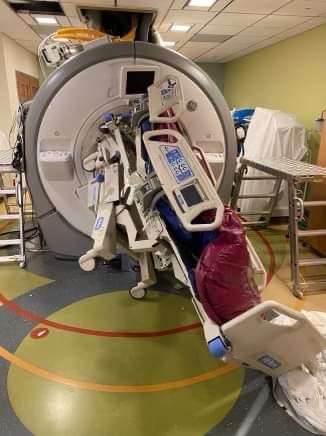
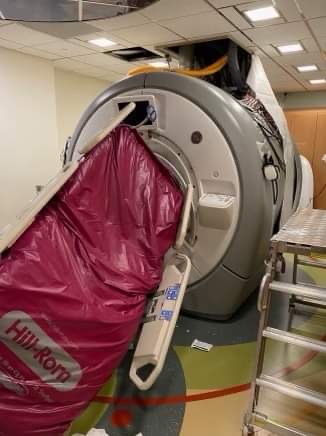
Several hours later, someone went into the room and took photos of the bed jammed into the mouth of the now inert MRI to document this disaster. We believe that the pictures were intended just for internal purposes, but at least some of those photos escaped containment and were widely circulated throughout the radiology community, some reaching us. You can find a couple of these pictures in the show notes for this episode on invisibleforcepodcast.com. If you look closely at those photos, it also appears that someone came through and cleaned up the pools of blood from the floor below where the ICU nurse had been trapped against a scanner. They did an okay job, but there are reddish-brown streaks still available on the floor just in front of the scanner below the dangling bed in the pictures.
Specific details of what happened immediately after are kind of scarce, other than that the nurse was sent for emergency surgery and spent some time in the ICU. One of the rumors was that Kaiser actually moved the nurse to Stanford Hospital about six miles away, either because of the availability of a higher level of care or possibly to stem the spread of information among friends and colleagues who worked at Redwood City Hospitals who would have recognized the nurse. Perhaps, perhaps it was both reasons.
“Hi, we’re here with the patient for the postponed brain MRI.”
“This exam has blown up our schedule today. Wait here, we’ll need to transfer the patient. We’ll be going in head first, but first I need to go to the control room and register the patient… [CRASH] Noooooo!”
While the specific dialogue and inner thoughts of the people portrayed in this episode weren’t actually recorded, our reconstructions are based on the events described in the official incident reports and from numerous confidential sources.
As tragic as this accident was, the actions that happened after the horrific accident will show some shocking true colors. We may have told you the story of the accident itself, but it’s really what happened after that in some ways. That’s the more alarming part. Starting with our next episode, we’re going to be digging into this aftermath.
For this week’s show, our sources were the CMS Statement of Deficiencies Report, the Cal-OSHA Investigation Report, Kaiser Permanente Northern California MRI Policies, and a whole bunch of confidential sources, both from within Kaiser and outside. Our radio play reenactment for this episode was voiced by Julia Shafini and Amanda McLaughlin.
We’d also like to offer a thank you to those who use their MRI Safety Week presentations to recommend this podcast to their audiences. Special shout out to Professor Martin Graves, Bill Faulkner, and Kelly Chia for mentioning Invisible Force.
If you have any information about this MRI accident or really any MRI accidents, please reach out to us through our website, invisibleforcepodcast.com. In addition, there you’ll find episodes, show notes, and tip line information. You can leave us a voicemail with information about MRI incidents at area code 631-MRI-TIPS. That number again is 631-MRI-TIPS or 631-674-8477.
We’d also like to encourage you to check out Rethink Imaging Podcast. The Rethink Imaging Podcast has an amazing variety of recorded interviews with a huge cross-section of radiology professionals. And a couple of their recent episodes include an interview with me, all about MRI safety, MRI safety week, and about the podcast you’re listening to right now. Like us, you can find Rethink Imaging on Apple podcasts, Spotify, or your other favorite podcast service.
Lastly, we ask you to like and share our podcast with your friends and colleagues and coworkers. With your help, we’ll unravel the mystery of what happened at Redwood City and with a little bit of luck, together we’ll help make sure that accidents like this don’t ever occur again.